We start by considering for . It was a task in the real analysis to try to figure out how to extend the factorial to the rational numbers or even the real numbers. After some analysis of the following integral: 1;;, we found out that this faithfully extends the notion of what a factorial should be.
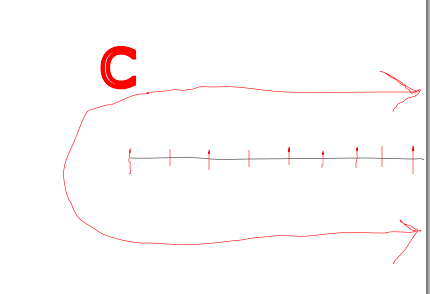
Now using integration by parts on the integral above, we get the factorial identity 1;;. Now we would like to define this integral for complex numbers. To do this, we apply 3. Theorem 2.4.1 - Residue Theorem. We integrate along the curve
This curve is a limit of smaller curves . We first take the limit as goes to infinity, and then the limit as goes to . Using this process we can continue the gamma function to the entire complex plane except the negative integers and 0. Using this contour we find that:
We would really like to divide by , which means that this value should be non-zero. We can see that this value is only zero when and . But we already know that the Gamma function is well defined for positive integers, so the only problem is and the negative integers. So we use the above formula as our definition for the Gamma function.
is defined
We also have the following trigonometric identity for the gamma function:
But we didn't really show how we got this identity.
We can show that there is a simple pole at , and use this fact to see that there is a also a simple pole for every negative integer. Using our identity above, we can find the residues of the gamma function around each of these points.